
- Lean teams run short of specialist skills because budgets are flat while the work keeps growing
- A full-time hire brings one discipline, plus recruitment costs and weeks of waiting
- Keep positioning and sign-off in-house, and outsource specialist work such as tracking and web strategy
- Choose a partner by who does the work, response times, notice periods and who owns the files
- Start with the jobs that block revenue and review what you need after 30 days
Quick answer
A small marketing team can get specialist help without hiring by bringing in an outsourced or embedded team for the skills it lacks, such as design, web development, analytics or AI search. Keep strategy and sign-off in-house, and choose a model that matches how often the work comes up, from one-off projects to monthly hours.
Your team of three has a webinar on Thursday, a pricing page to rebuild and a CEO asking why the company never comes up in ChatGPT. Nobody on the team is a developer, and the analytics specialist left in the spring.
That's daily life for a lot of B2B marketing teams: plenty of plans, and too few specialist hands to carry them out. An outsourced marketing team fills that gap with the skills you lack, for the hours you need, without adding headcount.
This guide compares the ways a lean team can get specialist help, from freelancers to an embedded team, with real costs for each. It also covers what to keep in-house and how to choose a partner you'll still be happy with in six months.
1. Why do lean marketing teams run short of specialist skills?
Because the work has grown while the budget has stayed put. Gartner's 2026 CMO Spend Survey found marketing budgets "remain effectively flat" at 7.8% of company revenue, up from 7.7% in 2025 (Gartner, 2026). In the same survey, 56% of CMOs said their marketing organisation lacks the budget to deliver its 2026 strategy, and 54% reported insufficient resources.
Those figures come mostly from large companies, and the squeeze is often tighter in a scale-up. Marketing Week's 2025 Career & Salary Survey found 54.9% of marketers are being asked to do more with less, up from 40.1% the year before (Marketing Week, 2025).
The skills gap sits on top of the budget gap. In Marketing Week's 2025 research into B2B marketing, 51.5% of B2B marketers said their department has an AI skills gap (Marketing Week, 2025). Another 38.9% pointed to a lack of data and analytics expertise.
Specialist work also arrives in lumps. A website migration or a broken CRM integration rarely fits neatly into one person's week, and the CMS always seems to break just before the board meeting.
2. What does it cost to hire a specialist instead?
More than the salary, and usually for one skill at a time. In the UK, the median full-time salary for a marketing and commercial manager was £55,215 in April 2026, according to provisional figures from the ONS (ONS, 2026). The US median annual wage for marketing managers was $166,790 in May 2025 (US Bureau of Labor Statistics, 2025).
Then there's the cost of finding them. The CIPD's 2026 resourcing report puts the median cost of recruiting a senior manager at £3,500, and £2,000 for other employees (CIPD, 2026). It also found 53% of organisations that tried to recruit in the past year struggled to attract candidates. SHRM's 2025 benchmarks put the US cost per hire for non-executive roles at $1,200 (SHRM, 2025). The median time to fill a role was about a month and a half.
The bigger catch is coverage. One good hire brings one discipline, and a lean team usually needs several of them. Think design, web development, analytics, technical SEO and AEO (answer engine optimisation, which gets your brand cited in AI answers). A full-time hire makes sense when the work in a single discipline is steady enough to fill a week, every week.
If you hire one generalist to look after the website and the tracking, that's a lot of hats for one person to wear. It's no slight on them to say they're unlikely to be an expert in all of it, and getting expert external support covers those gaps.
The Creative & Growth Team gives you senior design, web, analytics and AEO help on one monthly plan. Book a call.

3. What are your options for specialist help without hiring?
There are four common routes, and most lean teams end up mixing two of them. Each suits a different shape of work, so look at what's on your backlog before you compare prices.
Freelancers
A good freelancer is quick to brief and great for a narrow, well-defined task, such as a set of ad variations or a single landing page. The catch is coordination: you become the project manager, and a holiday or a full diary can stall a launch.
An agency on a project fee or retainer
Agencies bring a team and a process, which suits a defined project like a rebrand or a new website. Big retainers are harder to justify on a tight budget. In Gartner's 2025 survey, 39% of CMOs planned to cut back on agency budgets (Gartner, 2025).
A fractional leader
A fractional CMO or head of growth works with you part-time on strategy and priorities. That's valuable when the plan is what's missing, though someone still has to build the pages and fix the tracking.
An embedded specialist team
An embedded team gives you senior specialists across several disciplines for a set number of hours each month. Paddle Creative's Creative & Growth Team works this way. We think of it as the marketing team behind your marketing team.
You send the requests, and we diagnose each problem before bringing in the right person for it. That saves you from working out whether a slow landing page needs a designer or a developer.
Larger companies buy specialist help in a similar way. In Deloitte's 2024 Global Outsourcing Survey, 50% of executives used outsourced services for front-office capabilities, a group that includes sales and marketing (Deloitte, 2024). Deloitte also found skilled talent and agility now sit alongside cost reduction as reasons to outsource.
4. What should you keep in-house, and what should you outsource?
Keep the work that depends on knowing your customers and your company inside the team. That includes your positioning, your priorities, the relationship with sales and the final say on what goes out. Nobody outsources knowing the customer.
Hand over the work that needs deep skill in short bursts. When a new client joins the Creative & Growth Team, tracking and web strategy are almost always the areas they need support with. Tracking shows which campaigns bring in pipeline, and web strategy decides what your website needs to do for sales. Both take skills that are rare in a team of three, and nobody volunteers to untangle the tag manager on a Friday afternoon.
These are the jobs that usually go to a specialist team first:
- GA4 and server-side tracking
- Website strategy and new pages
- Technical SEO and AEO
- Forms and CRM integrations
- Campaign design and sales decks
- Page speed and accessibility checks
Our guide to marketing automation for B2B covers which automations to set up first.
AI can take some production work off a small team, as long as it sticks to your brand. Our rule for it is short:
Humans set the creative direction. AI follows your rules.
A written tone of voice for AI content is what keeps the output sounding like you.
5. How does an outsourced marketing team work day to day?
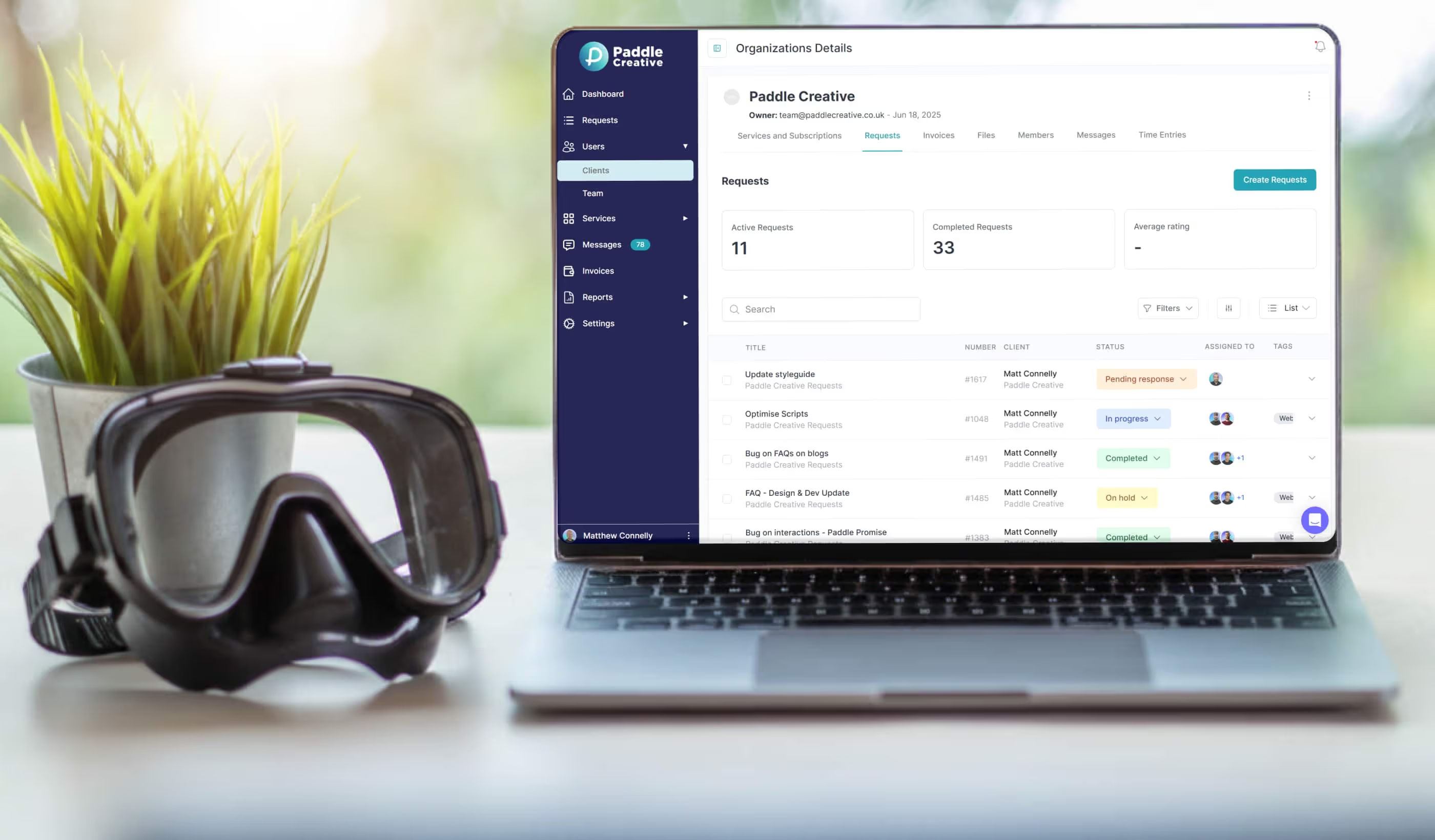
It should feel like having extra people in the team, with one place to ask for things. With Paddle Creative, requests go through our client portal. You hear back within 24 hours in UK business hours, or 48 hours on pay as you go. A project manager keeps everyone aligned, so you're spared the job of chasing five people for one answer.
Paris Blockchain Week shows what that looks like over time. Their site needs constant updates for new speakers and schedule changes (Paris Blockchain Week case study). Paddle Creative has kept it current through the portal for three years. Over that time, the partnership has supported the event's growth to 30,000+ visitors and its move into new areas such as AI.
Support can also grow out of a single project. Gaia Fertility came to us for a new website on a tight three-week timeline (Gaia Fertility case study). They have kept working with Paddle Creative for more than two years since, including support for their launch in the USA.
Specialist help also gets more out of the tools you already pay for. Gartner found marketing leaders were using just 33% of their martech stack's capability on average in 2023 (Gartner, 2023). That's a lot of software sitting idle with a renewal date attached.
The arrangement works best when your side is ready for it:
- One owner who signs work off
- Access to your CMS and analytics on day one
- A clear definition of done for each request
- A monthly review of hours used and what's next
6. How much does an outsourced marketing team cost?
Most providers charge by the project or by the hour. Paddle Creative's Creative & Growth Team runs on monthly plans, all plus VAT:
- 5 hours: £595 a month (about $750)
- 10 hours: £995 a month (about $1,250)
- 20 hours: £1,800 a month (about $2,300)
- 40 hours: £2,995 a month (about $3,500)
- Unlimited: £3,950 a month (about $5,150)
Pay as you go is £125 an hour + VAT (about $155), and the hours last 12 months. Monthly plans need 30 days' notice, with no minimum term after the first month.
For comparison, the UK median salary for a marketing manager works out at about £4,600 a month. That's before employer costs, recruitment fees and the weeks it takes to fill the role, and it buys one person's skills, however many disciplines your backlog needs.
7. How do you choose the right outsourced marketing partner?
Start with published work that looks like your problem, then ask how the arrangement works on a bad week. These questions separate the good partners from the rest:
- Who does the work, and how senior are they?
- How fast do they reply, and in which time zone?
- What's the notice period, and is there a minimum term?
- Who owns the accounts and the code?
- How do they use AI, and who checks the output?
- Can they show published work like yours?
Watch for the arrangement where every small change needs a developer and a quote. Our piece on the Webflow agency trap explains how teams end up paying a developer to fix a typo. If you're weighing up doing website upkeep yourself, we've also compared DIY and outsourced website maintenance.
8. How do you get started in the first 30 days?
Start small, with the jobs that block revenue. A broken demo form beats a new brand video for urgency, however much more fun the video sounds.
- Week 1: list the backlog and rank it by revenue impact
- Week 1: share access and name one owner
- Weeks 2 and 3: check your tracking, then clear the urgent fixes
- Week 4: review the hours used and set next month's priorities
After a month, you'll know which skills you need every week and which you only need now and then. That's the moment to decide between more hours and a hire. If you'd like to see how the Creative & Growth Team would handle your backlog, book a call. For the bigger picture on brand, our B2B branding guide is a good next read.
Sources
- Gartner 2026 CMO Spend Survey Finds CMOs Allocate 15.3% of Marketing Budgets to AI, But Only 30% Are Ready to Scale AI Capabilities, Gartner (2026)
- Gartner 2025 CMO Spend Survey Reveals Marketing Budgets Have Flatlined at 7.7% of Overall Company Revenue, Gartner (2025)
- Gartner Survey Finds 63% of Marketing Leaders Plan to Invest in Generative AI in the Next 24 Months, Gartner (2023)
- More with less the tough reality for over half of marketers, Marketing Week (2025)
- Half of B2B marketers grappling with AI skills gap, Marketing Week (2025)
- Earnings and hours worked, occupation by four-digit SOC: ASHE Table 14, ONS (2026 provisional)
- Advertising, Promotions, and Marketing Managers, US Bureau of Labor Statistics (2025)
- Resourcing and talent planning report 2026, CIPD (2026)
- 2025 Recruiting Executives Benchmarking, SHRM (2025)
- Global outsourcing survey 2024, Deloitte (2024)
Author
Fact Checked By