
.svg)
%20(1).avif)
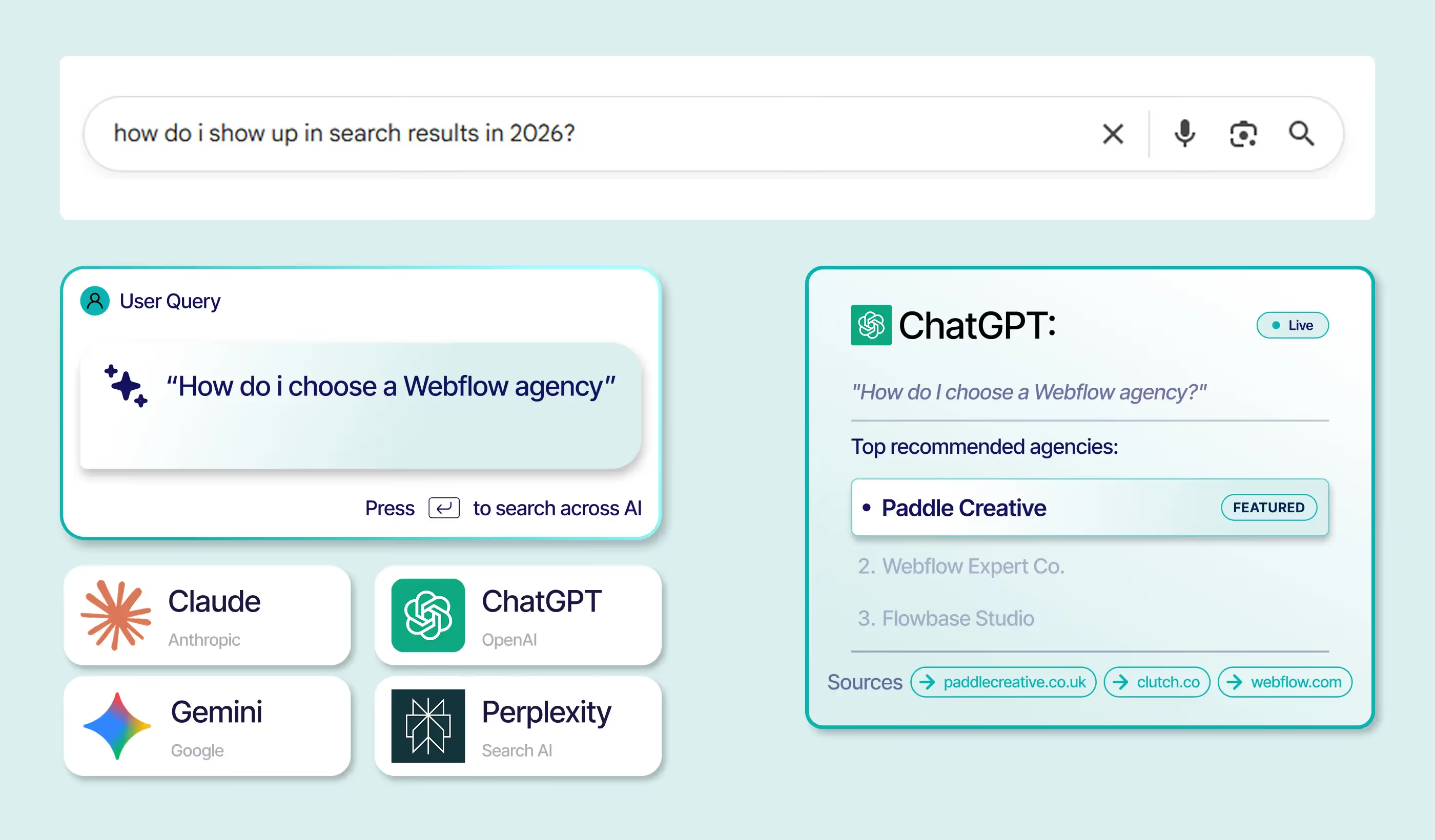
- SEO in 2026 rewards content that adds something new. Pages that repeat what's already online get ignored.
- Google leans on user experience, page speed and helpful content written by people who clearly know the topic.
- Showing up now means optimising for AI Overviews, ChatGPT and Perplexity, not just blue links.
- Structured data and answer-first formatting help AI engines quote you.
- Quick wins still work: internal links, sharper metadata and faster pages.
- Compress images and cut unused scripts to speed up your pages.
- Add structured data so AI engines can read and quote your content.
- Put a clear question and answer near the top of each page.
- Link related pages together to spread authority.
- Refresh your top pages with new data and a current date.
The role of SEO in modern marketing
What is SEO in 2026? SEO (Search Engine Optimisation) is the strategic process of improving a website's visibility across search engines and AI-powered discovery platforms. Traditional keyword ranking still matters, but modern SEO focuses on information gain: offering something genuinely new, an insight or data point that isn't already ranking, so AI models can cite you and users find you useful.
Search has moved beyond ten blue links. Engines now deliver answers through AI-generated summaries (Google AI Overviews), conversational results, featured snippets (the boxed answer that sometimes sits above the normal results) and rich snippets (listings enhanced with extras like star ratings or FAQs). Your site has to be 'machine-readable', so engines and AI can parse it, while staying 'human-centric', so it still converts.
Why SEO matters for organic traffic
Organic search drives 53% of all website traffic, outperforming paid ads and social media. Ranking high isn't only about the top three results anymore. Visibility now spans multiple formats, from rich snippets and featured results to AI-generated summaries. Optimising for SEO, structured data and AI-driven search keeps your brand visible wherever users are looking.
For example, the first organic result on Google gets an average click-through rate (CTR, the percentage of people who click your listing after seeing it) of 32%, according to DemandSage. Positions further down the page see far less interaction. If your goal is to rank higher on Google, SEO belongs at the core of your marketing strategy.
SEO's impact on website performance and Google rankings
Google evaluates a wide range of signals when ranking a site, including content quality, user experience, page performance, backlinks (links from other sites pointing to yours, which act like votes of confidence) and topical authority (how much Google trusts you on a given subject). The exact weighting stays private, but Google increasingly rewards pages that show E-E-A-T: Experience, Expertise, Authoritativeness and Trust.
Staying ahead with up-to-date SEO insights
Google's algorithm constantly evolves, so you have to keep up to hold your rankings. Updates like the Page Experience Update show the shift toward rewarding genuine user satisfaction over older tactics like keyword stuffing (cramming a page with the same term to game rankings, which now triggers penalties rather than gains).
This guide gives you practical, technical tips for modern SEO. From choosing the best website builder for SEO to what belongs on your contact page for SEO, every section helps you refine your strategy and boost visibility.
I. How does Google decide which websites rank first?
Understanding Google's ranking criteria is essential to ranking higher on Google. The exact algorithms stay confidential, but Google has published guidelines that show how to improve visibility and performance.
Google's search priorities
Google weighs three things heavily: relevance (does the page match the query), authority (can it be trusted) and experience (is it easy to use). Pages that hit all three rank more prominently.
Your contact page matters more than most people think. A well-optimised contact page for website SEO should include:
- Clear, accurate business information, kept consistent as NAP (Name, Address, Phone) across the web so Google trusts it.
- A clickable phone number for mobile users (a tel: link the phone dials on tap).
- Structured schema data (LocalBusiness schema: code that labels your business details so search engines can read them) to improve local search visibility.
These elements improve user experience and meet Google's usability guidelines.
The role of content in Google rankings
High-quality content is the cornerstone of Google's results. Content that answers the query directly, covers it in full and stays relevant is far more likely to reach page one.
Avoid repeating the same information across pages. This causes keyword cannibalisation (when two of your own pages target the same term and compete with each other, so neither ranks as well as one strong page would). Give each page a distinct job instead.
For example, if you target 'Best website builder for SEO', 'Best website platform for SEO' and 'Fastest website builders in 2026', make each page distinct. That avoids cannibalisation and builds you up as an authoritative source across different search intents (the reason behind a search: to learn, to compare or to buy).
Quick wins for SEO improvement
Sometimes small, strategic adjustments lead to quick wins for SEO:
- Image and video optimisation: compress files and serve modern formats like WebP to cut load times, and add descriptive alt text (the written description of an image that search engines and screen readers rely on).
- Mobile responsiveness: make the site work on every screen. Google uses mobile-first indexing, which means it ranks your site based on the mobile version, not the desktop one.
- Regular content updates: refresh pages so they stay current. Freshness is a ranking factor for time-sensitive topics.
These improvements cater to both user expectations and Google's algorithm updates.
How is AI search changing SEO?
Search behaviour is shifting fast as AI platforms like ChatGPT, Perplexity and Google's AI Overviews become everyday ways to find information. Rather than listing links, these systems summarise an answer and cite a handful of trusted sources. Optimising to be one of those sources is called AEO (Answer Engine Optimisation).
To appear in AI results, your content should:
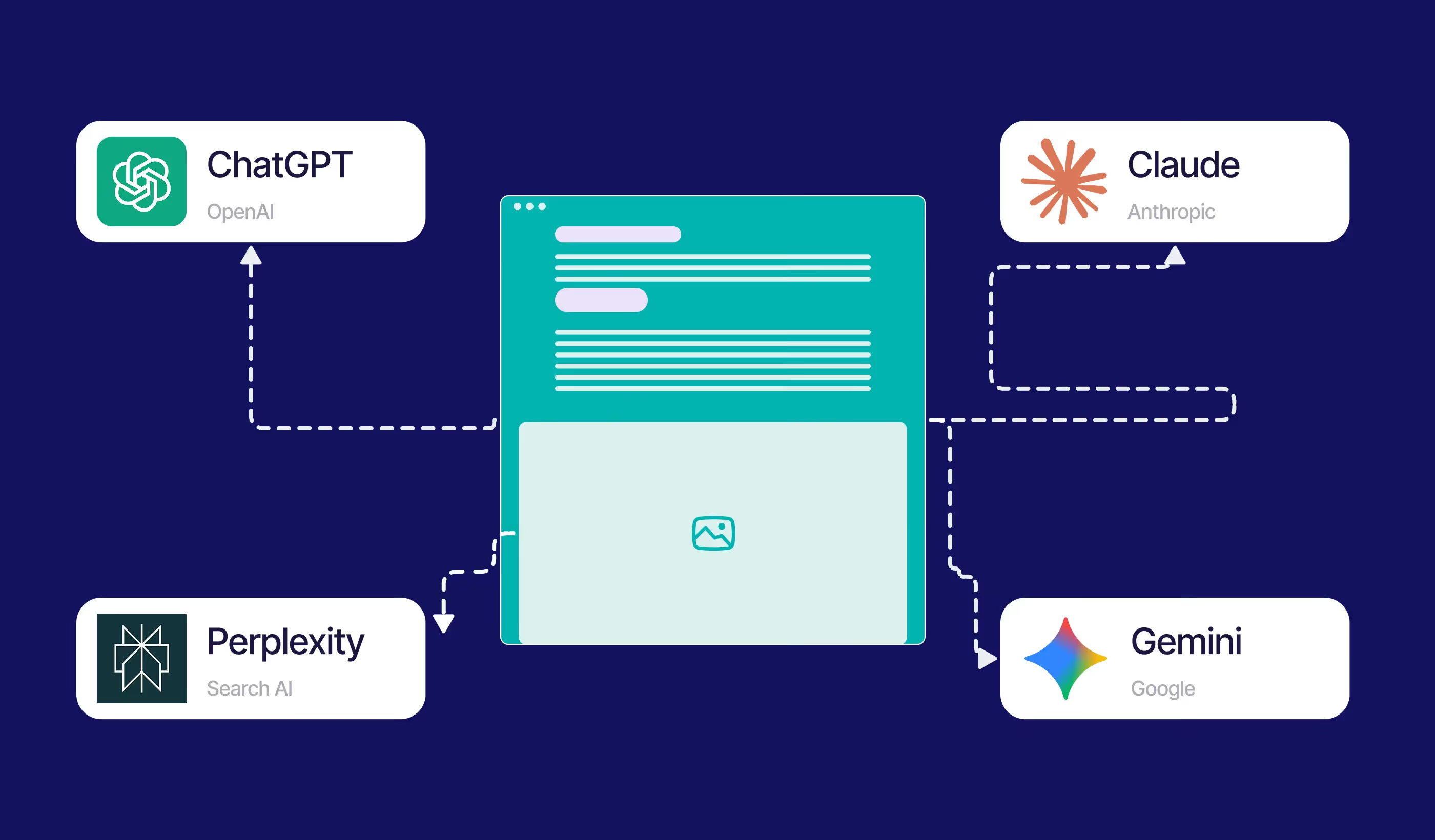
- be structured around clear questions and answers, so a model can lift a clean response
- use descriptive headings and structured data (JSON-LD schema, the code format Google recommends for labelling content)
- publish authoritative, in-depth guides that fully cover a topic
- build strong topical authority through clusters of related content
For marketing teams, this means writing answer-first content (lead with the answer, then explain) and structuring information clearly, not chasing keyword rankings alone.
II. The interplay between website design and SEO
Your design is more than aesthetics. It's a ranking factor. Clear navigation, fast loading and well-structured content all feed Google's signals, particularly Core Web Vitals (Google's three performance metrics, explained below).
Choosing the best website builder or programming language for SEO
The platform you build on sets your technical ceiling. Webflow, WordPress and Shopify are popular for their flexibility and SEO features. A strong website builder should give you:
- Integrated SEO controls: editable metadata (the title and description shown in search results), alt text and an XML sitemap (a file listing your pages so Google can find and crawl them).
- Clean, semantic code and fast loading: bloated code and heavy scripts drag down Core Web Vitals and push up bounce rates.
- Responsive design: the layout adapts automatically to mobile, tablet and desktop.
- Technical control: access to 301 redirects (permanent redirects that pass ranking value when a URL changes), canonical tags (which tell Google the preferred version of a duplicate page) and robots directives (which control what Google can crawl and index).
Webflow is a strong pick here because it outputs clean, semantic HTML and gives you native control over these technical factors without bloated plugins.
Core Web Vitals: the performance metrics that matter
Google measures real-world page experience through three Core Web Vitals:
- Largest Contentful Paint (LCP): how long the main content takes to load. Aim for under 2.5 seconds.
- Interaction to Next Paint (INP): how quickly the page responds when someone taps or clicks. Aim for under 200 milliseconds.
- Cumulative Layout Shift (CLS): how much the layout jumps around as it loads. Aim for under 0.1.
You can check all three in Google PageSpeed Insights or the Core Web Vitals report in Search Console.
Optimising font sizes, alignment and paragraph spacing for SEO and readability
A subtle but real factor is typography. Google recommends:
- Body fonts of at least 16px. Anything under 12px hurts readability and pushes up bounce rates.
- Generous paragraph spacing and a line height of around 1.5, so the page is easy to scan, especially on mobile.
Comfortable reading keeps people on the page longer, which improves dwell time (how long a visitor stays before returning to the search results) and engagement signals.
Avoiding design pitfalls that harm SEO
Poor design holds back rankings even when the content is strong:
- Slow-loading pages: large, uncompressed images and render-blocking scripts wreck your LCP.
- Cluttered layouts: too many competing CTAs bury the action that matters and hurt conversions.
- Repeated or thin content: near-duplicate pages confuse crawlers and can trigger a quality demotion.
A clean layout with one clear next step balances engagement and SEO.
Quick wins: improving SEO through design
Small design tweaks can lead to fast improvements in visibility and rankings. These include:
- Adding descriptive headings and subheadings in a logical H1, H2, H3 hierarchy with target keywords, for scannability and structure.
- Adding structured data (FAQ, Article and Breadcrumb schema) for richer search results and easier AI parsing.
- Prioritising mobile-first design to match how Google indexes.
By choosing the right tools and making design decisions with SEO in mind, your site can achieve both visual appeal and technical excellence, setting the stage for higher rankings and user satisfaction.
Talk to a Paddler about an AI Readiness check. We'll show you where your site stands in AI search.

III. How can you track SEO performance and rankings?
Even the most optimised website needs consistent monitoring to maintain and improve rankings. Tracking keeps your strategy aligned with the algorithm and with what users actually do.
Finding page rankings on Google with Google Analytics
Google Analytics (GA4) and Google Search Console (GSC) are your two core tools. GA4 tracks behaviour on your site; GSC tracks how you appear in search. Here's how to use them:
- Set up tracking: connect the site to GA4 and Google Search Console, and confirm tracking fires on every page, including contact and landing pages.
- Locate rankings: in GSC, open the Performance report and check Queries to see which search terms bring impressions and clicks, plus your average position for each. Look for queries like 'how to rank higher on Google' or 'quick wins for SEO to improve website'.
- Act on it: strengthen pages that already rank on page two (positions 11 to 20), where small gains move you onto page one fastest. Improve low performers with better content and design.
Addressing why your website might not rank on Google
If you're invisible in search, the usual culprits are:
- Crawling and indexing issues: crawling is how Googlebot discovers your pages, indexing is whether it stores them. Use the GSC Pages report and URL Inspection tool to find pages blocked by robots.txt, a stray 'noindex' tag, or a canonical pointing elsewhere.
- Thin or duplicate content: repeating information across pages is bad for SEO and can lead to a quality demotion. Consolidate the pages or make each one distinct.
- Lack of backlinks: too few authoritative backlinks (links from trusted external sites) limits your credibility. Earn them through useful content and digital PR.
Measuring the impact of SEO changes
Track every change against these metrics:
- Organic traffic: sessions from organic search in GA4.
- Engagement: bounce rate, average engagement time and click-through rate (CTR).
- Keyword rankings: tools like Ahrefs or SEMrush track position changes for keywords like 'Best Webflow development agency' or 'Webflow SEO optimisation guide'.
Quick wins for SEO: immediate improvements
Some changes get results quickly, even in competitive niches:
- Update metadata: sharpen your title tags (keep them under about 60 characters) and meta descriptions (around 150 to 160 characters) with target keywords. For example, 'Top-rated Webflow Development Agency in the UK | Paddle Creative'.
- Improve internal linking: add contextual links between related pages to spread link equity (the ranking value a link passes from one page to another) and help crawlers understand your structure.
- Website responsiveness: make sure the site works across all screen sizes and devices, mobile first.
IV. How do you optimise website content for SEO?
Content is the backbone of any successful SEO strategy. To rank higher on Google, you need purposeful, optimised material that matches search intent and reads well.
Understanding search intent
Search intent is the reason behind a query. Match the page to it:
- Informational intent: queries like 'Should I migrate to Webflow in 2026?' want answers and steps. Give a clear answer up top, then the detail.
- Commercial intent: phrases like 'Best website builder for SEO' show someone comparing options. Serve comparisons, benefits and a clear call to action.
- Transactional intent: queries with 'buy', 'hire' or 'pricing' want to act. Make the next step obvious.
Targeting long-tail keywords (longer, more specific phrases with lower competition) lets you match intent precisely and rank faster than chasing broad head terms.
The value of fresh, relevant content
Outdated content loses traction. Keep it current:
- Update year-specific lines, such as changing 'Best no-code website builders in 2026' to reflect the current year.
- Add new data, examples and tools to keep the page credible and useful.
Build comprehensive topic clusters
Topical authority (Google's trust in your site on a given subject) comes from organising content into clusters, also called content silos. A content silo groups related articles into thematic clusters (sets of pages all built around one central theme), which improves SEO and gives readers a structured journey through a subject.
What are content silos?
A content silo organises your pages into thematic clusters. Each cluster is built around a pillar page (a long, in-depth guide that acts as the main hub for a topic) supported by cluster content (shorter, focused articles that each cover a sub-topic). The supporting articles link back to the pillar page and across to each other, forming an interconnected web that search engines can map.
This internal structure signals to Google which topics you cover in depth, which lifts rankings for the whole cluster, not just one page.
Example: topic cluster for 'Healthy Eating'
If your central theme is 'Healthy Eating', the thematic cluster might look like this:
- Pillar page: 'The Ultimate Guide to Healthy Eating: Benefits, Tips and Recipes'
- Cluster content (supporting articles):
- '10 Easy Meal Prep Ideas for a Balanced Diet'
- 'Understanding Macronutrients: What Your Body Really Needs'
- 'Healthy Eating on a Budget: Tips and Tricks'
- 'Common Myths About Healthy Eating Debunked'
- 'Top 5 Superfoods and How to Include Them in Your Diet'
- Internal linking: every supporting article links up to the pillar and across to its siblings, passing link equity around the cluster and reinforcing your authority on the theme.
Benefits of content silos
- Improved SEO performance: Google reads the cluster as a sign of depth, lifting the pillar page and the supporting articles together.
- Better user experience: visitors move between related articles without leaving, finding everything in one place.
- Stronger keyword targeting: each article can target a different long-tail keyword, so the cluster covers a topic from every angle.
- Higher dwell time: interlinked articles keep people reading, and longer dwell time signals quality to search engines.
By organising content into silos, you build a scalable framework for dominating specific topics, which supports both user satisfaction and search engine favourability.
Paddle Creative insight
According to Ahrefs, 90.63% of content gets no traffic from Google, largely because it isn't optimised for search and doesn't match a user's intent. Writing for intent and readability, and updating regularly, lifts your odds of capturing organic traffic.
Content optimisation isn't about writing more. It's about writing better, around clear intent and genuine information gain. That keeps you ranking while keeping your audience engaged.
V. Long-term strategies for ranking higher on Google
Creating high-quality, evergreen content
Evergreen content stays relevant over time and consistently answers user queries, so it keeps pulling organic traffic and building your authority. To create it:
- Focus on foundational topics: address core issues that don't date, such as 'How to Create a Winning Content Marketing Strategy' or 'Key Elements of an Effective Website Design'.
- Use a mix of formats: add videos, infographics and long-form guides to make content engaging and shareable, which earns natural backlinks.
- Keep it fresh: update statistics, tools and examples, and refresh the 'last modified' date so search engines see the page as current.
Google rewards originality, so bring first-hand experience, client results or unique data rather than rehashing what already ranks. This is the Experience and Expertise part of E-E-A-T in action. For example, a blog titled 'Best web design trends 2026' could draw on case studies from your past clients.
Refreshing outdated posts
No matter how well it performs initially, outdated content eventually loses traction. Refreshing posts is the cheapest way to regain rankings:
- Step 1: audit your content with GA4 and Search Console to find posts with declining traffic or impressions.
- Step 2: add updated insights, more keywords, fresh images and current tools that weren't available when the post was first written.
- Step 3: refine meta descriptions, add keywords like 'Best techniques to improve CTR on a landing page', fix broken links and update the modified date.
For instance, a post on 'Best SEO Strategies to Follow' written in 2020 needs updates reflecting changes in platforms like Webflow or WordPress, including their newer SEO tools and performance improvements.
Building a strong internal linking structure
A strong internal linking strategy improves navigation, distributes link equity across your site and signals the hierarchy of your pages to Google. To build one:
- Use topic clusters: a main pillar page with in-depth content links down to several cluster pages, and they link back up.
- Anchor text matters: anchor text is the clickable wording of a link. Use varied, relevant phrases like 'effective content marketing strategies' rather than generic terms like 'read more', so the link tells Google what the target page is about.
- Avoid cannibalisation: give each page one clear keyword target so two pages don't compete. One could target a 'beginner's guide to SEO', another 'advanced SEO techniques'.
Internal links also reduce crawl depth (the number of clicks it takes to reach a page from your homepage), helping Google find and index deep pages faster.
VI. Measuring success: SEO metrics that matter
SEO is a continuous process that needs regular monitoring to gauge success and find areas to improve. Tracking the right metrics makes sure your effort turns into real outcomes like improved rankings, higher traffic and better engagement.
Engagement metrics to monitor
Engagement metrics show how users interact with your site. By watching these user experience signals, you can optimise for better rankings and retention.
- Bounce rate: the share of users who leave after a single page. A high rate can signal irrelevant content, poor design or slow load times. Pro tip: use GA4 to find high-bounce pages and improve readability, visuals and load speed.
- Engagement rate (GA4): the share of sessions that were meaningful, lasting over 10 seconds, converting, or including more than one page view. A high rate is a positive signal. Tip: add interactive elements like videos or quizzes to hold interest.
- Average engagement time: how long users actively spend on a page. Boost tip: use internal links to guide readers to related resources, such as a post on 'quick wins for SEO to improve website'.
- Click-through rate (CTR): clicks divided by impressions in search. Improvement: write compelling meta descriptions, include keywords like 'ultimate guide to local SEO', and use action-led language like 'Discover expert insights' so your listing stands out.
Tools for continuous improvement
Tracking metrics isn't enough on its own. You need tools to turn them into action:
- Google Analytics (GA4): behaviour and conversions. Use the Landing Pages report to see which pages attract the most traffic, and watch conversion rates.
- Google Search Console: your search performance. The Performance tab shows queries and average positions; the Pages report flags crawling and indexing issues.
- Heatmap tools (Hotjar, Microsoft Clarity or Crazy Egg): visualise clicks, scroll depth and where users drop off, so you can place key CTAs and links where attention lands.
- Rank trackers (Ahrefs, SEMrush): monitor keyword positions over time and audit your backlinks. Track terms like 'Best Webflow SEO Expert' or 'how to optimise my webflow website for seo'.
Tying metrics to business goals
Your SEO metrics should tie back to real marketing goals, whether that's generating leads, driving sales or building awareness:
- Set clear KPIs: for example, reduce bounce rate by 15% or grow organic traffic by 20% over the next quarter.
- Monitor regularly: review metrics weekly to spot trends or issues early.
- Act on data: use GA4 and Search Console insights to optimise content, improve user experience and adjust your strategy.
Paddle Creative insight
A report by Google reveals that 53% of mobile users abandon sites that take more than three seconds to load. Performance isn't only an SEO factor. It also cuts user frustration and lifts engagement. Run your pages through Google PageSpeed Insights, watch your Core Web Vitals, and keep improving.
VII. Conclusion
Recap of SEO best practices
The importance of SEO in achieving and sustaining online success is hard to overstate. By focusing on the fundamentals, performance, user experience, structured content and topical authority, you make sure your site isn't just functional. It's optimised for visibility and engagement.
Regular updates and monitoring for sustained growth
SEO isn't a one-and-done effort. Regular updates to your content, structure and technical elements are essential to hold rankings and adapt as Google's algorithms evolve. GA4 and Search Console give you insight into ranking results on Google and help you spot why a page might underperform. Staying proactive on technical health, user engagement and keyword performance supports sustained growth.
Final thought
The digital marketing landscape keeps shifting, and SEO is no exception. Quick SEO wins buy short-term visibility, but a long-term strategy compounds. By applying these SEO insights consistently, you keep your content competitive, hold your rankings and stay visible to the people you want to reach. Stay proactive, adapt to changes and prioritise user satisfaction.
The SEO checklist: your key to success
View the complete checklist in Google Sheets here. Duplicate it and make it your own.
The checklist runs from foundational tasks like keyword research and on-page optimisation through to technical audits, structured data and backlink analysis, so nothing critical slips. Copy it into Google Sheets, set your KPIs, goals and a timeline, and work through it.
- Organic search drives 53% of website traffic, more than paid or social.
- The first organic result earns about a 32% click-through rate.
- Page speed is a ranking signal: 53% of mobile users leave after three seconds.
- AI tools like ChatGPT and Perplexity cite structured, answer-first content.
- Topic clusters build topical authority and keep people on your site.
Author
Fact Checked By




.avif)


.avif)


%20(1).avif)
%20(2).avif)
.avif)
%20(1).avif)
.avif)
.avif)
.avif)
.avif)
.avif)
.avif)
.avif)
%20(1).avif)





.avif)
%2520(1).avif)

.avif)
.avif)


